

The invisible utility: decoding the modern cloud bill
For decades, building a digital business meant buying steel. IT departments were anchored by humming server rooms, heavy depreciating hardware, and massive upfront investments: the classic Capital Expenditure (CapEx) model.
Then came the cloud, and everything shifted.
At its simplest, cloud cost is the price of renting the future. It is the total amount of money a business spends to harness remote computing resources: the servers, databases and global networks owned by tech giants like Amazon Web Services (AWS), Microsoft Azure and Google Cloud Platform (GCP).
By migrating to the cloud, enterprises traded heavy iron for pure agility, pivoting to an Operational Expenditure (OpEx) model. Instead of buying physical hardware upfront, businesses now pay a variable, recurring “utility bill” based purely on what they consume.
It is the ultimate double-edged sword of modern business. The cloud offers infinite, frictionless scalability at the push of a button. But as many modern enterprises are finding out, when you leave the faucet running on a utility this powerful, the monthly bill can drain a budget before you even realise it’s on. To master the digital economy, leaders must first master the architecture of cloud cost.
Compute: the engine of innovation
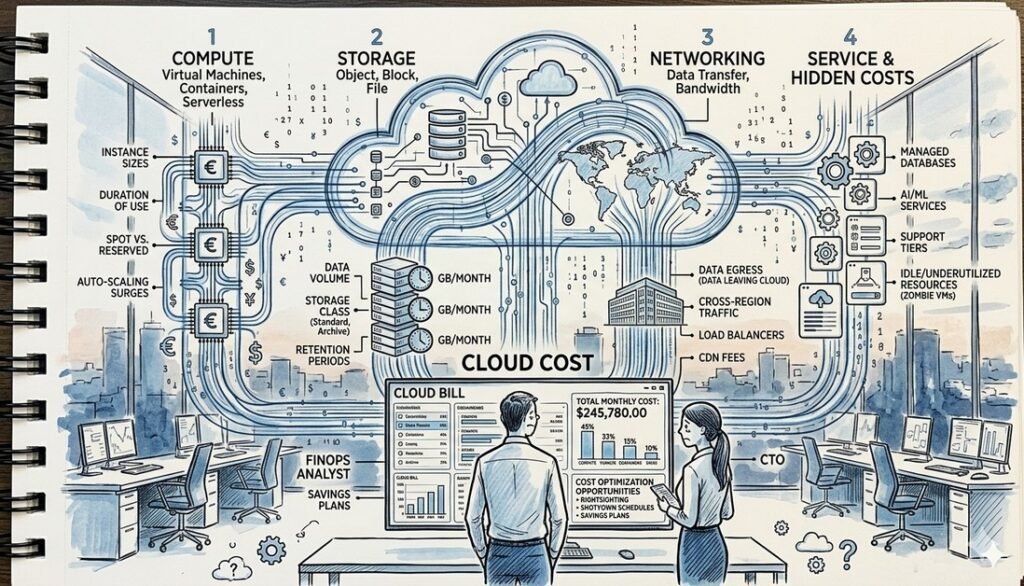
The compute pillar is the primary powerhouse of the cloud, typically accounting for 45% of total expenditure. While it drives application performance, its flexibility often leads to significant waste if not strictly governed.
Core drivers of compute cost
- Virtual machines (VMs) and instances: costs are dictated by the “family” selected (for example, memory-optimised vs compute-optimised). Choosing a powerhouse instance for a simple task is a leading cause of budget overruns.
- Containers and Kubernetes: while offering high efficiency, the management layers and underlying infrastructure clusters introduce their own overhead costs.
- Serverless (for example, AWS Lambda): billed per execution and duration. It is highly cost-effective for “bursty” workloads but can become a liability if used for continuous, high-volume processing.
Optimisation strategies
- Rightsizing: matching instance performance to actual workload demand. Scaling down from a large to a medium instance can yield immediate savings.
- Autoscaling caps: while autoscaling handles traffic spikes, without caps an unexpected surge can lead to a massive, unchecked bill.
- Reserved Instances (RIs): committing to one to three years for discounts of up to 70%.
- Spot Instances: using spare capacity for discounts of up to 90%, ideal for fault-tolerant tasks.
Storage: the data dilemma
Storage is the cost of holding the vast amounts of data generated and managed by modern organisations. Storage costs are deceptively complex, involving multiple tiers and hidden access fees. It isn’t just about how much data you have, but how often you touch it and how long you keep it.
The lifecycle of data costs
- Data volume: the absolute amount of data stored, measured in GB or TB. This is the most visible cost driver.
- Storage class (standard vs archive): standard storage is expensive but provides instant access. Archive storage (for example, S3 Glacier) is very cheap but has significant costs for data retrieval and longer retrieval times.
- Retention periods: organisations must define clear policies. Holding data “forever” because storage seems cheap is a costly mistake.
Optimisation specifics
- Lifecycle management policies: automating the transition of data between storage classes based on access frequency, for example moving data from standard to archive after 90 days.
- De-duplication and compression: reducing the physical footprint of the data itself.
Networking: the cost of connectivity
Networking is the virtual architecture that connects an enterprise’s compute power, databases and applications to each other and to the global internet. It is perhaps the most critical and least understood source of hidden costs. In the OpEx model, data movement is metered, so understanding how traffic flows through this virtual grid is critical, because in the cloud, architecture is finance.
The complexity of data transfer
- Data egress (data leaving the cloud): data ingress is typically free, but any data that leaves the provider’s network for the internet or an on-premise location incurs costs. This includes serving content to users or backing up data to an external location.
- Cross-region traffic: sending data between geographical regions of the same provider (for example, from AWS US-East to AWS EU-West) often incurs separate, substantial transfer fees.
- Load balancers: distributing traffic among multiple targets carries an hourly cost, plus costs for the data processed.
- CDN fees: content delivery networks (like CloudFront) cache content globally. They reduce direct egress from the origin but introduce their own tier-based transfer pricing.
Optimisation specifics
- Architecture design: designing applications to minimise data movement, such as processing data in the same region where it is stored.
- VPC peering and endpoints: using direct, internal network paths to connect services (for example, an S3 Gateway Endpoint), which can bypass expensive data transfer fees.
Service and hidden costs: the long tail
It is a common misconception that cloud optimisation is only about core infrastructure. While compute, storage and networking are the heavy hitters on a cloud bill, the long tail of specialised services is where budgets quietly derail. In the modern cloud, convenience comes at a premium. Managed services like automated databases, serverless functions and machine learning pipelines relieve the burden on IT labour, but they introduce steep, variable usage fees. Individually these line items seem harmless, but left unchecked they can hollow out an enterprise IT budget.
Key elements
- Managed databases (RDS, DynamoDB): outsourcing database management is a great time-saver, but it shifts labour costs into permanent infrastructure premiums.
- AI/ML engines: from pre-built models to custom SageMaker deployments, machine learning is a massive resource drain. Costs can spiral overnight based on training durations, data volumes and live endpoint queries.
- The escalating support tax: enterprise support plans are tied directly to total usage. When your compute bill spikes, your support bill spikes right alongside it.
- Zombie VMs: abandoned testing environments are the silent killers of enterprise margins. Left unmonitored, idle virtual machines rack up thousands in phantom charges.
Optimisation specifics
- Tagging and financial attribution: you cannot optimise what you cannot measure. Comprehensive tagging bridges engineering and finance, letting enterprises trace every dollar back to a specific project or department.
- Automated off-switches: by scripting the automatic shutdown of dormant dev environments and orphaned storage disks, companies can eliminate waste before the weekend even starts.
FinOps: the integrated view
You cannot manage modern tech in a vacuum. It takes a unified, data-driven approach to keep digital infrastructure from derailing a budget.
FinOps (Financial Operations) is the cultural and operational discipline that brings financial accountability to the variable, real-time world of cloud computing.
The modern cloud is an ecosystem of hidden cause and effect. A global footprint creates massive, interconnected dependencies. Heavy compute scaling in one region can silently trigger a cascade of cross-border networking and egress fees.
In the cloud, a single architectural shift ripples across the entire balance sheet.
Optimisation is a loop, not an audit
Optimisation is not a static, one-time audit; it is a continuous operational loop. To win, teams must lean into three high-ROI actions:
- Precision rightsizing: trimming fat by matching provisioned capacity to actual traffic demand.
- Dynamic shutdowns: automating the termination of idle, non-production (dev/test) environments after hours.
- Savings plans: locking in volume discounts by mapping out predictable, steady-state usage.
By mastering this four-pillar architecture and embedding a rigorous FinOps culture into daily engineering workflows, organisations can flip the script. What was once a chaotic, unpredictable cost centre becomes a lean, highly optimised engine of strategic enterprise growth.